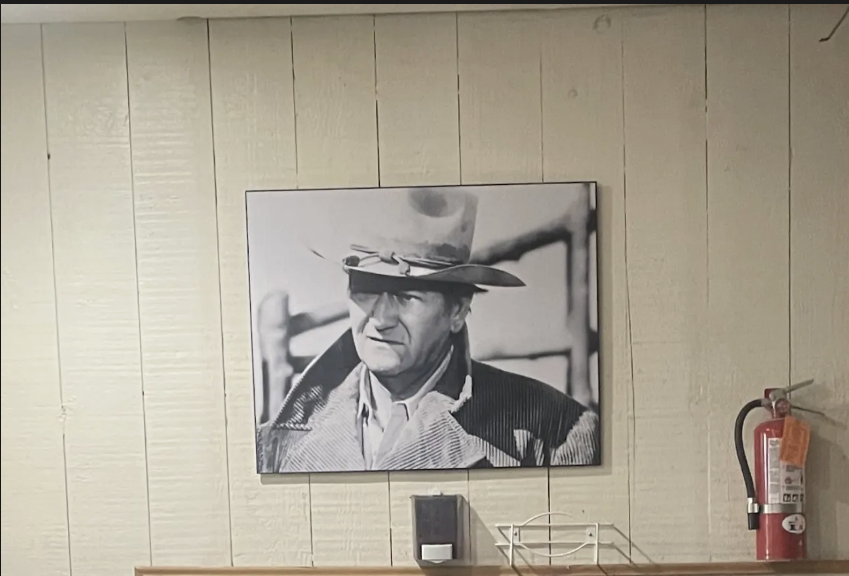
John Wayne, though from a majorly forgotten period, is very well known, his fame being so prolific that he has been able to stay relevant for 54 years even after his death in June of 1971. He has been an icon for decades, acting in about 170 films throughout his career. His movies are still being watched today. Senior Segerstrom students in Film, Literature, and Composition might have caught him as Ethan in the 1956 film The Searchers. California natives have undoubtedly heard of John Wayne Airport, named after the actor who was born in Orange County. People all over the country, and for generations, have fond memories of watching his beloved movies like True Grit or Rio Bravo with their dads or grandfathers who grew up with John Wayne movies.
And while John Wayne’s on-screen persona as “The Duke” is timeless, the man himself was not as heroic as his movie depictions. In modern times, he is remembered for being a fraud and an extremely racist person who hurt the film industry more than he helped it.
Wayne may have played tough military war heroes throughout his career, but he was famously exempt from serving in World War II, as he was the only provider for his kids, and more interestingly, because Republic Pictures did not want their biggest star to enlist. This would be his biggest controversy while he was alive, with people considering him to be a “phony” for then playing soldiers in his movies. Despite what he was labeled, it ultimately wasn’t his fault that he couldn’t enlist.
The same level of scrutiny and criticisms of cowardice were directed at others like Frank Sinatra, who was deferred due to his damaged eardrum. Wayne may be viewed as supporting the war effort from home by making movies that boosted morale, but since many in Hollywood served in the war, like James Stewart, Henry Fonda, Kirk Douglas, Frank Capra, John Ford, and others, his efforts were viewed as less significant under the microscope.
John Ford would, in fact, go on to persecute Wayne while directing on the set of the 1945 film They Were Expendable. This was due to the fact that most people on the set served, leaving Wayne as the shamed outlier. Wayne’s co-star, Robert Montgomery, served in the Navy as Ford did. But one day, the hazing became so bad that Montgomery had to step in so that Ford would leave Wayne alone. Another time, Wayne walked off the set, boiling because Ford had mocked his military salute.
His acting has also been criticized as being outdated and stiff compared to the modern standard, which requires a range that he did not possess. This was a sentiment he himself shared. Explaining his lack of depth, Wayne once remarked, “All I do is sell sincerity, and I’ve been selling the hell out of that since I started. If I don’t, people will stop coming to see me and producers won’t hire me because I can’t sell their films.”
Poorly aged acting wasn’t his only offense, as it was the least contentious mark in all his controversies. The second biggest stain on his reputation was his involvement in blacklisting several Hollywood directors and actors for not sharing an anti-communist view, as Wayne and the industry themselves did.
In 1944, Wayne famously funded the Motion Picture Alliance for the Preservation of American Ideals, the MPA, and the House Un-American Activities Committee, HUAC. The alliance organized against any perceived communist Hollywood material, while the latter famously handled the Hollywood 10 investigation, which saw actors and directors blacklisted from Hollywood because they were suspected of being communists. Being blacklisted in Hollywood is a “death wish” for careers because it means those accused will not be able to work in that field. Even today, this happens to many actors, such as Keanu Reeves, who was blacklisted from Fox for about ten years due to not wanting to star in the sequel to the exceptionally successful Speed (1994).
Ultimately, John Wayne’s most everpresent controversy would undoubtedly be his racism. While it was a different time with different attitudes towards racism, it doesn’t excuse his behavior or actions, especially to the extent to which it occurred. His racist views were so repugnant that, in 2020, the Democratic Party made an effort to remove his name and statue from the aforementioned John Wayne Airport.
Wayne would brand himself as a white supremacist in a 1971 Playboy interview. When referring to black people, he stated, “With a lot of blacks, there’s quite a bit of resentment along with their dissent, and possibly rightfully so. But we can’t all of a sudden get down on our knees and turn everything over to the leadership of the blacks. I believe in white supremacy until the blacks are educated to a point of responsibility. I believe in giving authority and positions of leadership and judgement to irresponsible people.”
The group that bore the worst of Wayne’s racism was Native Americans. In that same interview, Wayne justified his perspective: “I don’t feel we did wrong in taking this great country away from them, if that’s what you’re asking. Our so-called stealing of our country from them was just a matter of survival. There were great numbers of people who needed new land, and the Indians were selfishly trying to keep it for themselves…”
These attitudes come as no surprise, given that he came from a time when Western films treated Native Americans as inhuman savages. His portrayal of Ethan from the previously mentioned film, The Searchers, does attract modern controversy because of the character’s racist nature. Ethan was a Native American-hating Civil War veteran who aggressively hunts down his niece after finding out she became a part of a Native American tribe. Despite his earlier attitude, Ethan eventually changes his ways and brings his niece back to the family. Wayne’s choice to play a character like this, given his beliefs, doesn’t spell well.
Probably the most famous example of his prejudice against Native Americans was the Oscars incident of 1973, in which a Native American activist named Sacheen Littlefeather rejected Marlon Brando’s Academy Award for his role in The Godfather at that year’s show. She was meant to give a ten-minute speech, but it never came to fruition because she was cut off and later blacklisted. The immediate reaction of the audience, full of Hollywood’s elite, was shock and discontent. The most notable reactions were from Clint Eastwood, Joe Pesci, and, of course, John Wayne. His reaction was the most worrisome, as he was behind the curtain while she was up on stage. Wayne became so enraged that he had to be held back from rushing the stage by multiple security guards. His intention was not fully clear, but it’s been heavily inferred that he was trying to rush the stage to either stop or assault Littlefeather during her speech.
A beautiful aspect of film is that on-screen characters will live forever, even as the people behind those characters fade away. In the case of John Wayne, the controversies that have followed him are unlikely to fade. But, to students studying film, he can always be remembered as the Duke, the larger-than-life cowboy soldier, immortalized on the silver screen and at our county’s airport.