As of late, a variety of news publications and journalists are experiencing conflicts with the Trump administration. This oppositional relationship is significantly more pronounced compared to his past term, with reporters occasionally receiving abrupt and sometimes considered harsh responses.
Recently, when President Trump was boarding Air Force One, he was quoted as telling a reporter, “quiet, piggy,” in response to her questioning him about his alleged relations with Jeffrey Epstein. These occurrences between President Trump and reporters are shown to be more frequent. He’s been recorded calling reporters “stupid” or disregarding their questions in a manner that many news sites claim to be unbefitting of the president. As a result, these more inflammatory remarks have been garnering a lot of attention by the media.
For the incident when Trump called a reporter “piggy,” outlets like CBS and CNN have titles that described his actions as “lashing out” or “snapping” at her. Additionally, the video taken of the interaction showed Trump approaching the reporter slightly, appearing to lean forward a few inches. Despite this, a lot of sensationalized sources, like TikTok, have videos, podcasts, or articles in which they claim Trump lunged at the reporter. These reactions specifically come from a more liberal audience. Meanwhile, more conservative outlets tend to report more on the reasons behind the responses. They cite Karoline Leavitt’s, the White House Press Secretary, opinions on the matter. She explained that Trump provided his answer as a result of improper behavior on the reporter’s part by supposedly rudely asking questions and spreading “fake news.” Leavitt emphasizes that President Trump is a “frank” person, a quality that she views as beneficial for a president to hold.
It is generally expected among news outlets that the president will act in a professional manner with reporters, as it’s the job of the press in America to keep government officials accountable. However, when the relationship between the two grows unstable, that job becomes difficult to execute and may be subject to speculation.
As mentioned, there is a rise in coverage of small moments of outrage rather than viewing the incidents for what they are and what they mean. The U.S.’ First Amendment details very specific rights, and the one most pertinent to these events is the right of the press and the right of free speech. These are essential rights not only to be protected but to be known. Fully understanding this is understanding the foundation of the U.S. government and how democracy prevails. Democracy is protected by leaving enough power to the people, powers like speech to question and challenge our elected officials. Through this, people can begin to understand that the opposition between the U.S. executive branch and the press marks a challenge to these First Amendment rights.
It is understandable for people to react harshly to information that seems rude to them. But when people become elected officials, there’s an expectation of diplomacy, even in the face of unkind behavior and possibly baseless allegations. So, when it seems that the government is shifting towards being restrictive in their interactions with the press and more willing to disregard their questions, concern should arise. But, as a result of many sides of the political spectrum being oversaturated by biased media, these concerns are focused more on a blame game, where either Trump is the problem or liberal media sources are the problem.
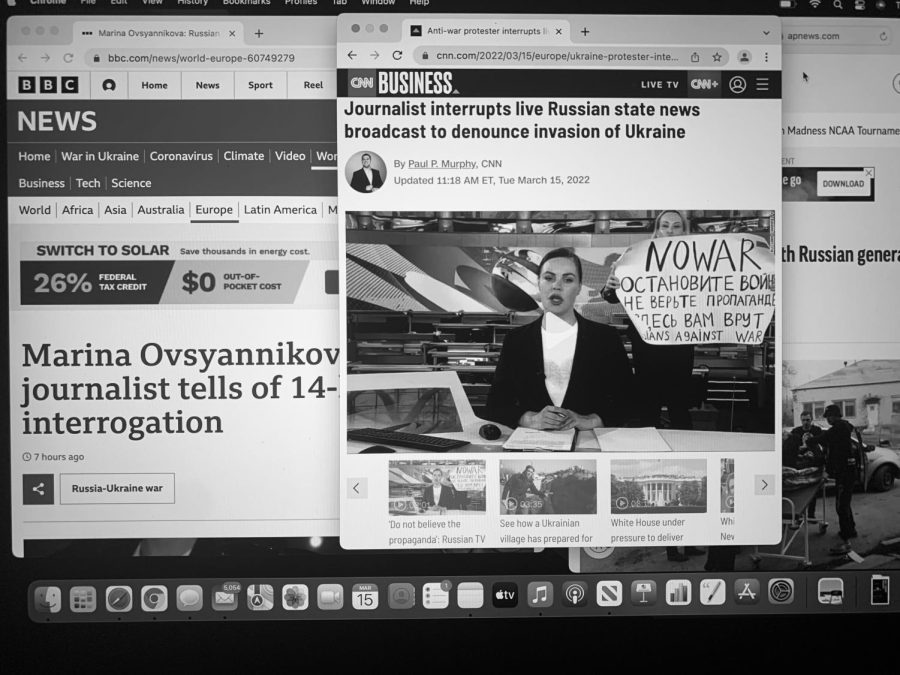
Instead of engaging with opinion pieces on a regular basis, it is important to look at the real facts of the situation through first-hand accounts and recordings of the events. It’s important to engage with the media on both sides of the political spectrum. It’s important to be educated. Segerstrom offers a number of history classes as well as a required government and economics class. These classes are not just significant because they are a part of students’ grades, but because they educate us about our society. Even a basic engagement in a government class allows a student to recognize pertinent problems in society and form their opinions based on factual information. This literacy is essential in our day-to-day lives. Rather than feeding into the constant stream of dopamine and strong emotions that a political bubble, such as TikTok, provides, it is important to take a moment to see what is really happening in the world around us.