On January 7th, a 37 year-old woman, Renee Good, was fatally shot and killed by ICE agents carrying out their operations in Minneapolis. Many differing opinions have come out about the situation, the main sources of which are the Department of Homeland Security’s spokesperson Tricia McLaughlin and Minneapolis Mayor Jacob Frey.
With this incident including ICE and DHS, it’s become another contentious topic between political groups. As seen lately, this results from the facts of the situation being muddled. Still, factual information stands, as the scene was recorded by bystanders, seeming to be opposed to the ICE operations. Looking at the footage, Good had her vehicle parked horizontally in the road, blocking ICE agents from proceeding through. After a moment, the officers exited their cars to approach her. There were three officers to the left of her car when one went to grab the door handle of the driver seat, prompting the victim to reverse and then attempt to drive off. It’s important to note that one officer was in front of the left of her car when she went forward. However, video forensics has confirmed that the tires were not directed toward the officer, so it’s unlikely the intention was to hit him. This is when shots are heard, with the vehicle still moving forward and an ICE agent being seen putting his firearm in its holster. The vehicle would then crash into an electric pole, as the victim was shot in the head. With the use of video forensics, again, it’s seen that no ICE officer was physically harmed in the ordeal.
McLaughlin posted a statement on X, explaining that “rioters began blocking ICE officers and one of these violent rioters weaponized her vehicle.” According to her, the officer, who ultimately shot the victim, was “fearing for his life” and “fired defensive shots.” She would further explain it was the fault of certain government officials encouraging people to interfere with ICE operations in a violent manner, and that the officers were being demonized.
Frey, in response, had a press conference to address the situation. He was quoted using expletive language to address ICE, stating he wanted them out of their city. Frey has continued with public appearances and speaking with the press to address the situation. He’s explained that he wants the situation thoroughly investigated by the city and the state.
As the situation has developed, it’s become a tool for furthering the polarization of the American people, with those in support of Good being labelled as radicals, while those in support of ICE are seen to be backing an unregulated, militant organization. Not only does this undermine facts, what we can see and hear, but it detracts from the reality that a woman was murdered. To touch on Good’s situation, she was a poet, a mother of three, and wife of Becca Good. Many community leaders have been quoted regarding Good as very involved in the community and a kind, loving person. It may then be questioned if her acts warranted the response received. These conclusions can only be made by understanding all sides of the situation, which will be detailed below.
The ICE agent who was responsible for killing Good has been identified as Johnathan Ross. According to official records, garnered by AP News, Ross is an Iraq war veteran who has been serving as a deportation officer since 2015. Last summer, he had been seriously injured when he was dragged by a vehicle by a fleeing suspect. DHS has cited this experience as being responsible for the response he gave towards Good attempting to drive forward. It’s then notable to state that it’s an officer’s job, no matter what division, to deescalate a situation. The officers who approached Good’s car used a strong, even considered hostile, tone when requesting her to open her car door. As for Ross, he had already drawn his gun when Good was backing up, and fired after he had moved out of the way of the car. Those in support of ICE have said his response was understandable, as they believe Good to have been acting disorderly and violent. And, given Ross’ past, his fear may be justified. However, people expect officers to have more rationale than the average person or agitator. Since Ross has trauma regarding similar situations, rather than being in a position of power where he’d be prone to experience a violent encounter again, he should be receiving therapy and not be doing field work.
As for Good, Ross’s body cam footage has revealed that Good was using her car to block ICE officers. She was in her neighborhood doing what she believed would protect her community. Good and others on the scene were recorded verbally antagonizing the agents, though none took physical action, and all but one and Good were at a safe distance. While her word has been lost, it’s likely she was motivated by the fact that it was her community in danger. While ICE and DHS have explained that the deportations are set to target dangerous, violent criminals, there’s been many videos and explicit records showing that regular people have been targeted by ICE as well. Children have been left without parents, or, in one case, been used to draw out immigrant parents. Our legal process to become a citizen, important as it is, does not justify violence towards people who contribute to the country.
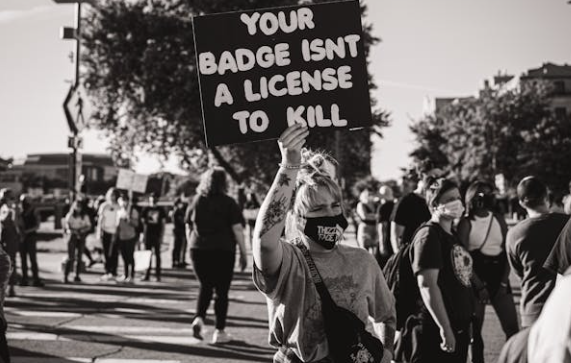
To focus solely on polarizing ideas leaves little room for empathy, especially in situations like these. And, while different opinions are more than valued in a society, things like violence and needless death violate the social contract that people, as a developed society, have formed. Just a day after Good’s death, two more people were shot by ICE in Portland. An ICE officer point blank drew their weapon on a protestor who was not engaging violently, though it was not fired. Still, in Santa Ana, parents fear leaving their homes or letting their children hang out with friends, lest their livelihoods be ripped from them. They’re our neighbors, our friends, or people’s families. When considering that perspective, Good’s actions may gain perspective.
Operations like ICE, if truly deemed necessary, shouldn’t be carried out in an unregulated fashion. The lack of training provided to agents in order to garner as many as possible is not a price that should be paid, especially when it comes at the cost of human lives. More care must be taken. Immigrants or not, protestor or not, these are people.